
Dare to let Freya’s paws loose on your thesis?
Freya roasts your thesis like a supervisor. The result? A professional analysis in 90 seconds.
What Freya hands back, when she’s done with your thesis
Get started for free →- 1
A readiness score, not a grade guess
Evaluated with leading research, calibrated to your university.

- 2
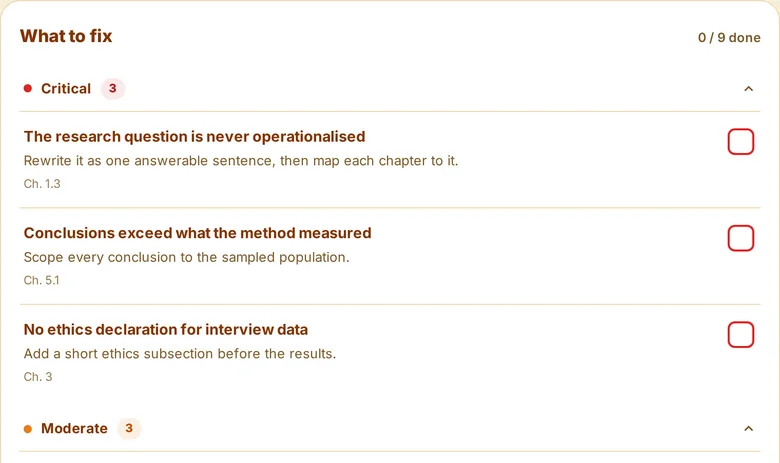
Clear steps you can work on
Critical first, each connected to its chapter. Tick them off once done: your score rises.
- 3
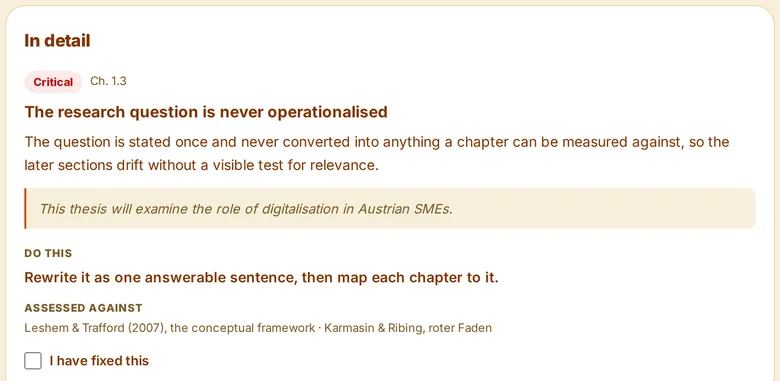
Tells you exactly what to fix, why and how
Marks your sentence and the literature it was judged against.
- 4
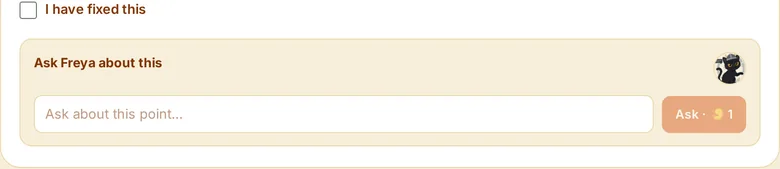
Argue back, on any point
Ask Freya about one finding and get a straight answer about your text.
- 5
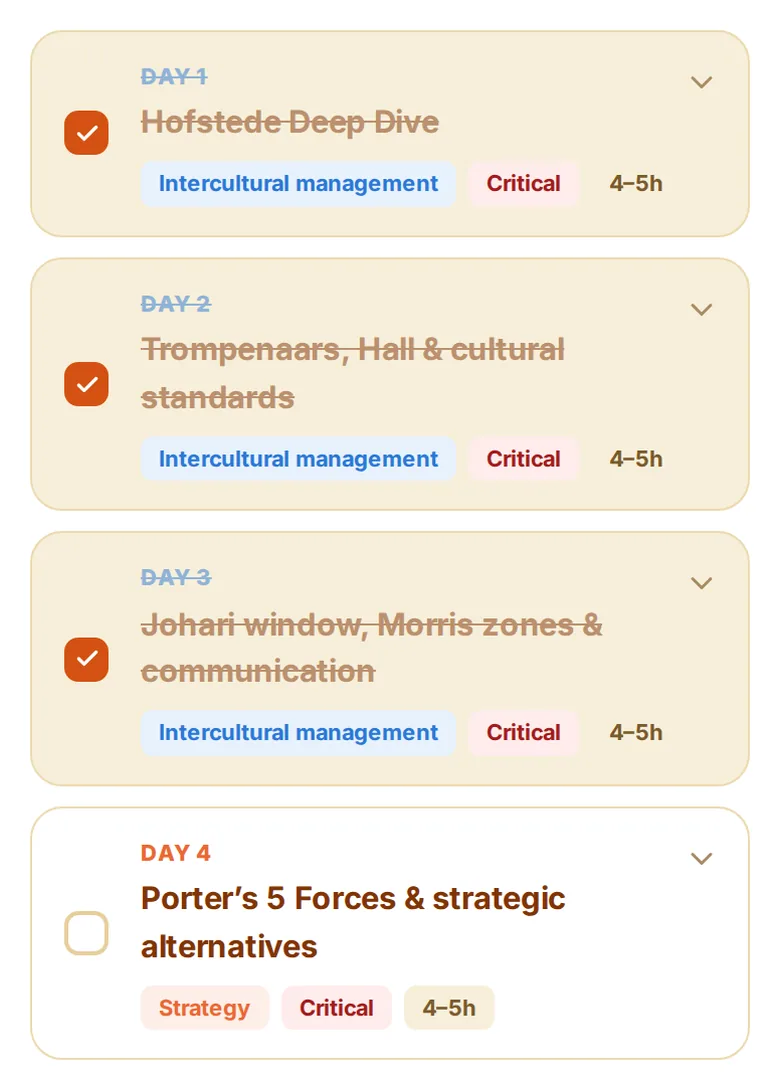
Then prepare for your exam
A day-by-day plan from your own documents, ordered by what gets asked.


Freya applies leading research right on your thesis.
Your thesis will be roasted the way it will be graded. Does your research question hold a thread all the way to your conclusion? Is your method argued and your research ethics declared? Does your chapter structure follow the sequence, layout and formatting rules of your university? Are your language and citations academic? Could anyone actually act on your recommendations? Your own literature has priority. Freya only applies her literature, if she can’t find yours in the thesis.
The 18 checks behind your score
Your question and the red thread
- Forschungsfragen stated, numbered, answerable, each mapped to a method
- The chain from question to theory to method to conclusion, unbroken
- Literature that positions your study, not a stack of summaries
Measured against the published standards- Kornmeier (2024) His standard guide requires a precisely formulated research question, defined key terms and a theory section the analysis builds on. A question the reader has to reconstruct does not count as stated.
- Leshem & Trafford (2007) They find that examiners look for an explicit conceptual framework tying theory, question and method together. A framework the reader has to infer counts as absent.
- Webster & Watson (2002) They require a literature review to be concept-centric rather than author-centric, and recommend tables and figures explicitly as the effective way to carry key claims.
- Swales (1990), CARS-Modell His CARS model describes what an introduction must do: establish the territory, name the gap, and state how this work occupies it. A missing gap statement is a structural defect, not a stylistic one.
- Karmasin & Ribing (2024) The Austrian standard reference sets the expected structure and the mechanical rules that follow from it: a heading level never has a single entry, and every figure is captioned and referenced in the running text.
Method and research integrity
- Why this method, argued against your own research questions
- Ethics: consent, anonymity and DSGVO declared, not assumed
- Enough detail that a stranger could repeat your study
Measured against the published standards- Döring (2023) Her standard methods text makes intersubjective traceability the reporting bar: design, sampling, data collection and analysis are documented so another researcher can follow and check every step.
- Helfferich (2022) She holds the interview guide to "as open as possible, as structured as necessary": its questions are derived from the research question, and the guide itself is disclosed so the reader can judge what the interviews could and could not reveal.
- Mayring (2022) His qualitative content analysis is rule-guided: the category system, its definitions, anchor examples and coding rules are laid down and reported, so the step from material to result can be checked. An unexplained "the interviews showed" is not an analysis.
- ÖAWI-Richtlinie zur guten wissenschaftlichen Praxis (2026) The Austrian integrity guideline treats taking over ideas, text or data (verbatim, paraphrased or translated) without marking the source as plagiarism: an unattributed claim is a matter of research integrity, not of citation style.
- APA Publication Manual (7th ed.) The manual fixes the mechanical contract between an in-text citation and its reference-list entry. Every in-text citation resolves to exactly one entry, and every entry is cited at least once.
Structure and formal rules
- The Austrian chapter sequence, and what each chapter must contain
- A real Limitationen section in the Diskussion, not one sentence
- Your Erhebungsinstrument (guide or questionnaire) in the Anhang
- No orphan sub-heading: if 3.1.1 exists, so must 3.1.2
- Font, margins and line spacing measured off your PDF, never guessed
Measured against the published standards- Webster & Watson (2002) They require a literature review to be concept-centric rather than author-centric, and recommend tables and figures explicitly as the effective way to carry key claims.
- Karmasin & Ribing (2024) The Austrian standard reference sets the expected structure and the mechanical rules that follow from it: a heading level never has a single entry, and every figure is captioned and referenced in the running text.
- APA Publication Manual (7th ed.) The manual fixes the mechanical contract between an in-text citation and its reference-list entry. Every in-text citation resolves to exactly one entry, and every entry is cited at least once.
Academic language
- Claims that reach further than your data can carry
- Register: “Ich” where German academic writing expects otherwise
- Gendern: a run of generic masculine forms gets flagged
- Citations formed to your style: APA, Harvard, Chicago, MLA or IEEE
Measured against the published standards- Esselborn-Krumbiegel (2022) The standard German-language writing guide holds academic register to precision over decoration: filler intensifiers and conversational asides cost credibility without adding meaning.
- Hyland & Tse (2004) They show that academic prose signals its stance through hedges and boosters; an unhedged absolute claims more certainty than the evidence behind it carries.
- Koutsantoni (2004) She documents how certainty markers are calibrated to evidence strength in published research. Appeals to what "is well known" stand in for the citation that should be there.
Practice relevance: the FH criterion
- A problem out of real practice, not only a gap in the literature
- Handlungsempfehlungen in the Fazit that someone could act on
- The bridge from your findings back to the field
Measured against the published standards- AQ Austria, FH-AkkVO 2024 The Austrian accreditation regulation commits every FH programme to practice-oriented education that enables graduates to solve the tasks of their professional field by the state of science and the requirements of practice. The standard an FH thesis is read against.
How our users see Freya
Roastgaard checked all 47 of my sources against Crossref. Three existed. I have since apologised to science.
Graded me on the real rubric of my professor in thirty seconds. My supervisor has had chapter two since March. It is now June.
No sign-up, no upload, and when I closed the tab my text vanished like my will to live at 2am. Beautiful.
Everything you need to know
Free? What’s the catch?
The roast is free and needs no account. Sign in (still free, no card) and you get 10 credits that rewrite the flagged passages in your own text. When those run out you can buy more, or not; nothing expires and nothing auto-renews.
My thesis is in German. Does that work?
Yes. German and English theses both work, and each is judged by its own academic conventions. The passive voice that German academic writing expects is never flagged as a mistake.
Does it know my university’s rules?
Upload your university’s writing guidelines (PDF or DOCX) and your thesis is checked against those rules, from citation style to layout, instead of a generic standard.
Isn’t this just ChatGPT in a costume?
No. Every citation is verified against the global DOI registry, and you’re scored on the rubric Austrian examiners actually use, not generic US-college advice. It never invents a source.
Is it a plagiarism or AI detector?
No. It doesn’t run a plagiarism check and doesn’t flag text as AI-written. It reads your thesis the way your examiner grades it: argument, method, structure, language and sources.
My thesis isn’t finished. Is it too early?
No, earlier is better. Roast a single chapter, or just your introduction, while you still have time to act on what it finds.
Can I check my whole thesis at once?
Yes. Sign in for free and upload your full thesis as DOCX or PDF. You get a first verdict right away, and the complete review follows within a few minutes.
Is the score my grade?
No. The score is an indicator of how good your work really is. The grade, however, comes from your supervisor. The score shows you what to work on before then.
Will my supervisor know I used it?
Yes, we notify your university the moment you use our service... Kidding. What happens in Roastgaard stays in Roastgaard. Viking’s honour ;-)

Built by students who wrote their own theses at 2am, unsure whether their self-esteem will survive the upcoming supervisor’s roast. Freya is the second supervisor we wish we’d had.